

PowerFactory Users' Group Conference 2011
Papers
Download the conference papers from this linkSummary of Proceedings
The 2011 PowerFactory Users Group Conference was successfully held in Melbourne, last month in Melbourne 24-26th February. The conference also coincided with the 10th Anniversary for DIgSILENT Pacific. Over 40 attendees were present, with representation spanning from Perth to New Zealand.
The theme of this year's conference was "Grid Compliance" with a focus on how users can incorporate and enhance their use of PowerFactory for the increasingly sophisticated demands of today's market. Delegates presenting papers included: Andrew Tuckey (PowerCorp), Marius Jansen (Alstom), Markus Poeller (DIgSILENT GmbH), Rizah Memisevic (PowerLink), Peter Willis and Hai Lee (both of DIgSILENT Pacific).
Markus Poeller, the CEO of the DIgSILENT group of companies was in attendance and presented two thought provoking papers and an informative session on small signal stability.
The program for the first day consisted of the delegates presenting papers.
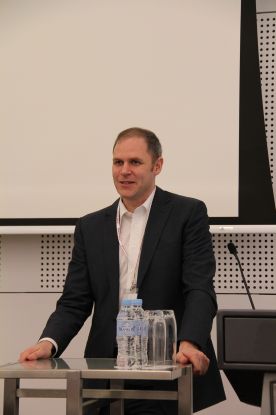
Tuckey's first paper presented a hardware-in-the-loop system created by simulating a power system in PowerFactory and connecting it via the object linking and embedding for process control standard (OPC) to controller hardware. This allows the overall system to behave like a real world power system with real controllers. This particular topic captivated the audience as it opened the door for endless opportunities to use PowerFactory in a real time environment and the ability to control hardware loops.
Tuckey's second paper for the day discussed a recent study of the impact of a planned wind farm in an isolated grid. The paper described the approaches for modelling an isolated power system with the integration of renewable devices, in this case a wind farm. Tuckey highlighted the importance of model verification and the consequences of making wrong assumptions during the simulation process. Data was captured after the commissioning of the system which was used to validate the model accuracy.
Poeller's first paper was a broad discussion on international studies on integration of wind generation; the first study was of grid integration of wind generation in South Africa, and the second was a study of integration of renewable energies into the German electricity transmission system. The paper discussed the approach undertaken when considering such studies, and presented a summary of results.
Poeller's second presentation for the conference was a demonstration the new "Generation Adequacy" function in PowerFactory, an in built Monte Carlo Analysis tool which allows one to assess the reliability of supply and quantifying the required installed capacity of the studied system. The demonstration showed the features of the new tool, including considerations and the approach of modelling renewable sources, load modelling and capacity credit for such studies.
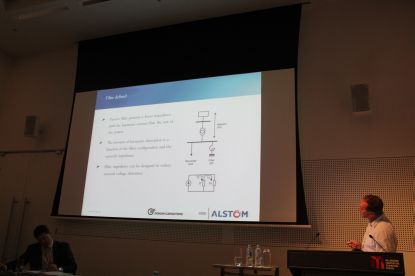
Jansen and Memisevic both presented papers regarding harmonic analysis. Jansen discussed the process for selection of harmonic filters to ensure compliance with IEC 61000, from an OEM point of view. He particularly emphasised three key aspects of the process as gathering harmonic information from existing networks, selection of harmonic filter structure, and robust design to ensure safe and reliable operation under all foreseeable network conditions.
Mesimevic, in contrast, discussed from a TNSP's point of view the impact of the modelling of transmission network components on the emission limits for distorting loads.
A tool developed in PowerFactory and MatLab was developed and presented to assist in calculating emission limits according to IEC 61000-3-6 standards.
The final paper of the day was presented by Hai Le. Le's paper presented a lightning insulation coordination study performed using PowerFactory.
The aim of the study was to ensure the equipment's insulation shall withstand voltage stress caused by lightning strike and efficient discharge of over voltages.
Le presented the approaches for modelling the network and key components and the techniques to achieve more accurate results when executing such a coordination study.
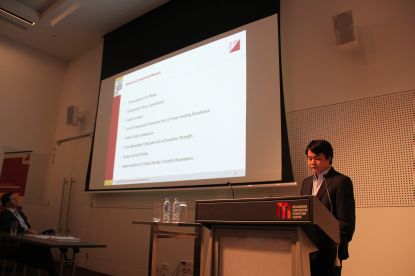
The second day was dedicated to an oscillatory stability tutorial presented by Poeller. The discussion concentrated on the concept of power system stability and the analysis and computation of stability. This was achieved with a simple demonstration of the classic "one machine connected to an infinite bus" problem. The model was developed from scratch to demonstrate the effect of including an excitation system and finally the introduction of a power system stabiliser (PSS). The tutorial concluded with a PSS tuning example using PowerFactory's fourier analysis tool by studying the phase relationship of the change in the speed signal input to the PSS to the change in generator torque. The concept was very well received, particularly by the regulators not familiar with the technique.
The user's group conference concluded on Saturday 26th February, with a lovely tour of Victoria's winery region in the Yarra Valley. The tour explored some of the finest wineries in the region and included wine tasting in the picturesque vineyards. The day concluded with an exquisite lunch and a toast to DIgSILENT Pacific's 10th Anniversary. Happy Birthday DIgSILENT Pacific!